

Betting Experience provides, alongside probability indicators, an Expert Mode designed for those who want to deepen the analysis of a single match through a broader set of information.
Expert Mode was created to offer a more complete reading of the context in which a match takes place: statistical data, market signals, and additional information that helps interpret what is happening.
It is a useful tool both for those already familiar with data analysis and for those who are less experienced but want to start understanding how to read numbers, odds, and market movements in a more informed way.
The information shown in Expert Mode does not replace personal judgment and does not eliminate risk.
Instead, it is an analysis support tool, designed to assist the user in evaluating a match by connecting different data points within a single context.
In the next sections we will look in detail at how to read the different types of data displayed, starting from their layout and the meaning of each indicator.
How to enable Expert Mode
Expert Mode can be enabled in two ways.
If you want to view all matches directly with advanced information, you can enable the “Expert Mode” option from the options panel on the homepage. This way, each event will be displayed with the full set of available indicators.

Alternatively, you can open Expert Mode only for a single match by clicking the “+” button to the right of the event. This option is useful when you want to investigate a specific match without changing the overall page view.

Once Expert Mode is enabled, advanced data is displayed in a structured format. In the next sections we will see how to interpret it correctly, starting with statistical data.
Data types and color legend
In Expert Mode, information is organized into visual categories to make reading easier and reduce cognitive load.
Each data type is associated with a specific color, helping you immediately recognize the nature of the information being shown.
Colors do not indicate the importance of a data point, but its role in the analysis: statistical, market-related, or informational.
Learning to distinguish them makes it easier to navigate quickly among the available signals.
BLUE — Statistical data
This section gathers team and competition statistics, built from historical results. Statistical data describes how teams have performed over time and provides an objective foundation for analysis.
RED — Odds movements
Values highlighted in red refer to odds and line movements. These indicators help observe how the market is reacting to a match, showing changes driven by the balance between demand and supply.
PURPLE — Betting volumes
This category covers how bets are distributed, when this information is available.
Volumes do not indicate a “correct” outcome, but show where market interest is concentrated at a given time.
PRED — Prediction
The prediction is a numerical summary produced by the Betting Experience algorithm, highlighting the outcomes with the highest probability based on available data. It is not a certainty, but a comparison tool that should always be interpreted together with the other information shown.
In the next sections we will analyze each category in detail, starting with statistical data and the correct way to read rows, columns, and combined values.
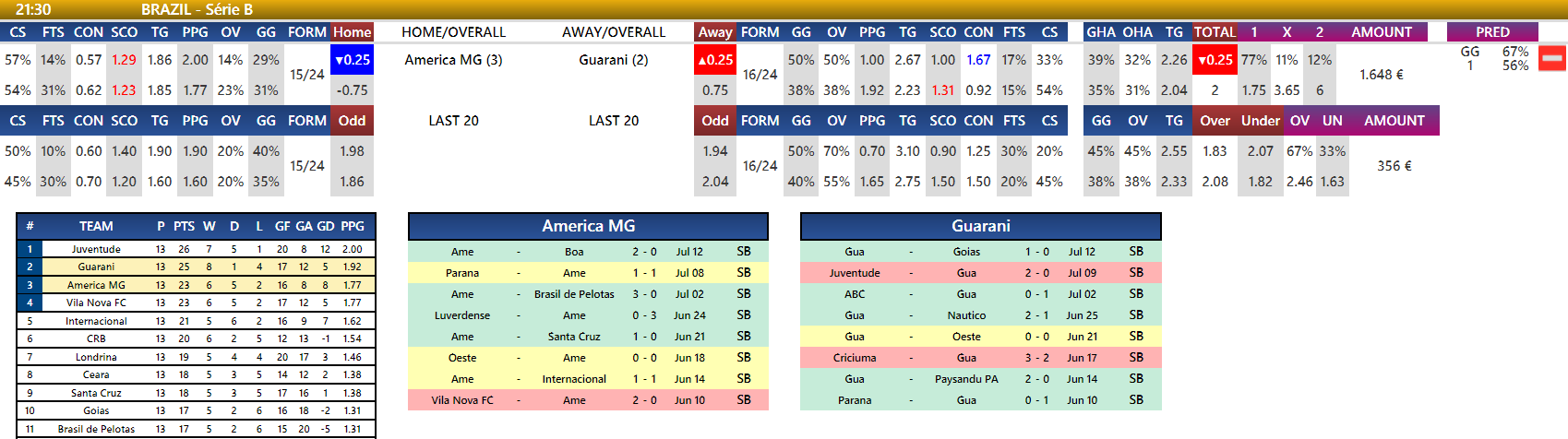
Statistical data: how to read the rows
Statistical data, highlighted with a BLUE header, describes team behavior over time. To interpret it correctly, it is important to understand what each row refers to and the context in which it should be read
Each match includes four statistical rows, representing data collected across different periods and contexts.
This allows you to compare recent performance and competition-specific performance, avoiding reliance on a single perspective.
- ROW 1 — Matches played in the current competition
(home matches only for the home team, away matches only for the away team) - ROW 2 — Matches played in the current competition
(all matches, home + away) - ROW 3 — Last 20 matches played across all competition
(home matches only for the home team, away matches only for the away team) - ROW 4 — Last 20 matches played across all competitions
(all matches, home + away)
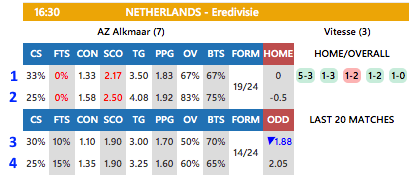
Rows should not be read in isolation. Comparing rows within the same column helps you understand whether a team is performing in line with its historical baseline or showing signs of recent improvement or decline. This approach provides context for statistical data and reduces the risk of interpretations based on samples that are too small or on non-representative periods
Once the meaning of the rows is clear, the next step is to understand what each indicator represents within the statistical columns.
Column meaning
Statistical columns describe how a team behaves in concrete terms, beyond the final score.
Each value is an average or percentage calculated over the matches considered in the rows described above.
Clean Sheet (CS)
Percentage of matches in which the team conceded no goals, keeping a clean sheet.
A high value suggests defensive solidity, especially if consistent across different rows.
Failed to Score (FTS)
Percentage of matches in which the team failed to score.
A high value indicates low attacking output, especially if consistent across different rows.
Conceded (CON)
Average number of goals conceded by the team.
Helps evaluate defensive vulnerability and should always be read together with the opponent’s attacking data.
Scored (SCO)
Average number of goals scored by the team.
A high value indicates attacking tendency, but should be contextualized by the strength of opponents faced..
Points per Game (PPG)
Average points earned per match
(win = 3, draw = 1, loss = 0).
A compact indicator of overall performance in the competition.
Over 2.5 (OV)
Percentage of matches ending Over 2.5.
Useful to understand whether a team tends to be involved in high-scoring games.
Both Teams to Score (BTS)
Percentage of matches in which both teams scored.
Indicates a balance between attacking ability and defensive concessions.
Form (FORM)
Total points earned in the last 8 matches
(or fewer, if fewer matches are available).
A quick snapshot of recent form.
These indicators should not be interpreted individually. Their value emerges from comparing rows, columns, and teams, helping build a more complete view of the match context.
Combined statistics
Combined statistics connect the home team and the away team, summarizing their behavior into average values.
These indicators help assess the statistical balance of a match, going beyond the analysis of each team separately.
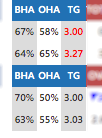
Both teams to score Home / Away (BHA)
Arithmetic average between the percentage of matches in which the home team recorded Both Teams to Score (BTS) in home games and the percentage of matches in which the away team recorded Both Teams to Score (BTS) in away games.
Useful to evaluate the likelihood that both teams will score.
Over Home / Away (OHA)
Arithmetic average between the percentage of Over 2.5 matches for the home team at home and the away team away from home.
Provides a combined indication of the match tendency to go over the 2.5-goal threshold.
Total Goals (TG)
Average of goals scored in the home team’s home matches and the away team’s away matches.
Represents an estimate of the expected total goals, based on both teams’ historical data.
As with individual statistics, combined statistics are also calculated across multiple rows, distinguishing between current-competition data and data from recent matches played.
This allows you to compare recent trends and structural team behaviors.
Asian market values
The Asian market is often among the first to reflect risk adjustments and betting flows.
For this reason, watching its values helps you understand how the market is rebalancing a match, often before changes become evident in traditional markets.
In this context, the team considered the favorite by operators is associated with a negative value (–), while the underdog is associated with a positive value (+).
The larger the negative value, the higher the implied probability assigned to the favorite winning.
Changes in these values over time indicate a shift in market balance toward one side or the other.
To interpret Asian market values correctly, it is useful to have a minimum familiarity with its parameters.
In this context, the favorite is associated with a negative (–) value, while the underdog has a positive (+) value.
The larger the negative value, the higher the implied probability assigned to the favorite winning.
Likewise, changes in these values over time indicate a shift in market balance toward one side or the other.
The main advantage of observing the Asian market is that these movements often reflect structural adjustments, linked to betting flows and risk management, rather than simple odds fluctuations.
Asian Handicap — overall movement
The Asian handicap describes how the market evaluates the gap between the two teams.
A change in the handicap (for example from –1.5 to –2) signals a structural adjustment in the market’s assessment of the match, often more relevant than a simple odds move.
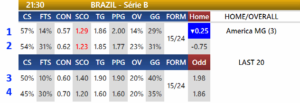
ROW1
The first row indicates whether the odds move is in favor of or against the team associated with the current line, compared to the opening line.
If there are no changes, the handicap remains the same; otherwise, the line may shift (for example by –0.5).
ROW 2
The second row shows the current Asian handicap.
A more negative value than the opening indicates the market assigns a higher implied probability to the favorite winning.
ROWS 3/4
These rows let you compare the current odds with the opening odds.
A drop in odds signals increased market interest on that side; a limited change may indicate that rebalancing happened mainly through a handicap shift.
Total Line — Asian total goals
The Total Line represents the total number of goals expected in the match according to the Asian market.
Changes in the line or its associated odds indicate whether the market expects a higher- or lower-scoring game..
Total Line — reading the rows
The first row signals a possible increase or decrease in expected goals.
The second row indicates the starting line, while the third and fourth rows allow you to compare current odds with opening odds.

In the following examples, we see how Asian market movements translate into the data, distinguishing between simple odds changes and structural line adjustments.
In the first example, the Asian handicap shifts by –0.5 in favor of the home team, with a resulting odds drop.
The change from –1.5 to –2 indicates that the market assigns a higher implied probability to the favorite winning.
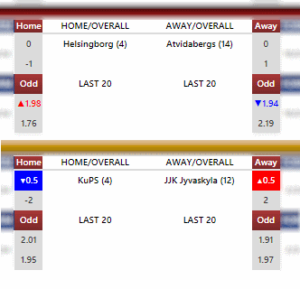
In the second example, the Total Line signals a decrease in scoring expectations.
Comparing the opening odds with the current odds shows how the market is recalibrating the expected number of goals in the match.
In both cases, reading line and odds together helps you understand whether the market is simply fine-tuning probabilities or making a deeper adjustment to its match assessment.
Betting volumes (Moneyway)
In addition to statistical data and odds movements, Betting Experience provides information related to betting volumes, when available.
These data help you understand how bets are being distributed on a match and which outcomes are attracting the most attention.
When available, the betting volume data shown by Betting Experience comes from the Betfair Exchange, one of the main exchange platforms, which allows you to transparently observe how stakes are distributed across the market.
Betting volumes provide an additional perspective on market behavior, showing where bettors’ interest is concentrated.
What is Moneyway
Moneyway represents the percentage distribution of stakes on a match, based on Betfair Exchange data when available.
This information shows how the total betting volume is split across different outcomes

1X2 volumes
This section shows the percentage of stakes placed on 1 – X – 2, relative to total volume.
A high concentration on a single outcome signals a strong imbalance in market interest.
Amount
Amount represents the total stake traded on the match.
Higher values indicate greater market involvement and a match more widely followed by bettors.
Over / Under volumes
This section shows how betting volumes are distributed between Over and Under.
Here too, a strong imbalance signals a clear market preference for one side.
Betting volumes should always be interpreted together with other indicators.
A volume imbalance can confirm an ongoing odds move or highlight a discrepancy compared to statistical data.
It is important to remember that betting volumes are a snapshot of market behavior at a given moment
Moneyway completes the Expert Mode information set, combining statistical data and odds movements with a direct view of betting flows.
In the next section we will see how all these elements — statistics, the Asian market, and volumes — can be read together within the platform.